



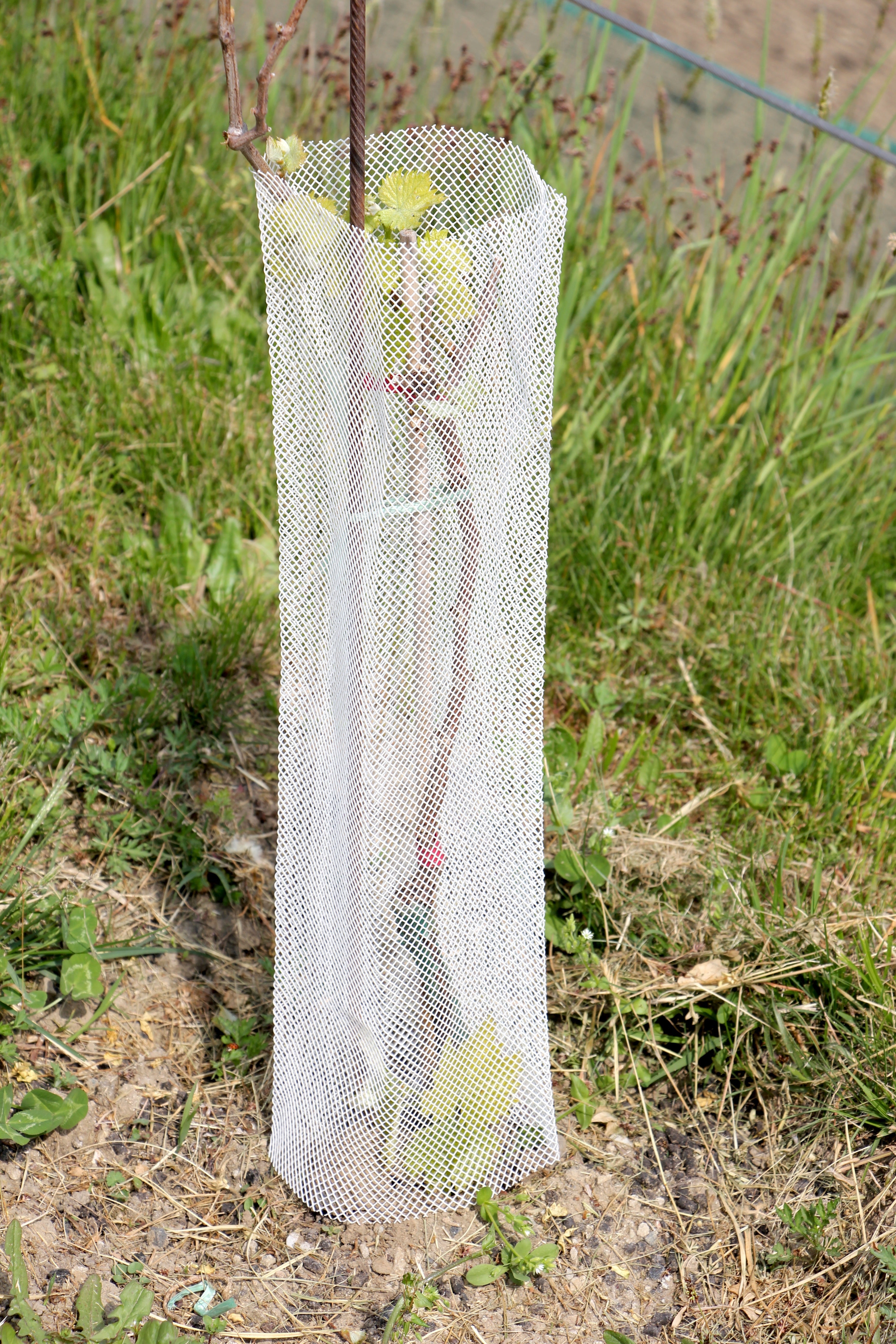
Meursault (Premier Cru): why a biodegradable net shelter is becoming a “supply-chain standard” for young vines
Product focus: Shelter Bio RODEX (Arbrì) in a high-density Chardonnay replanting
In bareroot vine replanting in the Côte de Beaune, attention typically concentrates on nursery material, rootstock choice, and water management. Yet on site, the factor that most often turns a “perfect-on-paper” planting into an uneven vineyard is the loss or damage of young plants in year one: wildlife (rabbit/hare/rodents), under-row mechanical impacts, herbicide drift, and repeated micro-stresses.
In a context such as Meursault—where the best exposures swing from Levant (East) to Midi (South), and soils are marl-limestone at elevations around 260 m—the oenological potential is exceptionally high, but a young vine remains completely vulnerable until it is fully established.
It is precisely in this technical gap—between qualitative ambition and operational risk—that Shelter Bio RODEX sits: a net-type protective shelter designed as a “leave-in-place” solution, particularly suited to precision viticulture and increasingly demanding environmental requirements across the supply chain.
Why protecting a young vine is not (only) an “anti-wildlife” decision
Scientific evidence on rabbit damage in vineyards is clear: browsing can be quantified, it correlates with animal abundance, and it can affect yield at the level of individual vines.
To this, an often underestimated agronomic fact must be added: in a young planting, even a limited percentage of missing vines generates indirect costs (replanting, heterogeneous canopy management, differences in vigor and ripening) that weigh on the vineyard for multiple seasons.
In parallel, technical press and extension work on vine guards / grow tubes consistently reports recurring benefits: improved survival, faster establishment, and reduced labor costs—plus a microclimatic effect that can reduce evapotranspiration. The University of Maryland also highlights that, under dry conditions and without irrigation, tubes can contribute moisture at the base via condensation, with potentially decisive impacts on survival in new plantings.
Bio RODEX fits within this logic, but with a distinct technical point: netting (rather than a solid wall) as a compromise between physical protection and controlled microclimate.
The technical advantage of netting: protection without a penalizing “greenhouse effect”
In viticulture, protection should not mean creating an artificial environment that drives long internodes and poorly lignified tissues. The choice of netting is relevant because it:
- promotes ventilation and exchange (reducing persistent condensation and micro-environments favorable to molds);
- maintains higher light transmission, supporting more balanced growth.
In Arbrì’s technical comparison between a biodegradable net shelter and paper/closed tubes, useful field-level indications are reported: 2–3 mm mesh with temperature, relative humidity, and CO₂ parameters close to ambient conditions and no condensation/mold, while closed tubes are associated with increased daytime temperatures and potential side effects on physiology and plant health (e.g., powdery mildew) due to reduced transpiration and light.
This becomes a supply-chain point: in a Premier Cru context, the shelter must be protective while remaining compatible with the objective of forming a robust trunk and an even, homogeneous planting.
Product focus: why Bio RODEX is well-matched to premium young vines
Bio RODEX is specified as 100% bio-based, with a reinforced structure and designed to break down naturally in the soil, without residues and without removal.
In young vineyards, the specifications that truly matter are:
2×2 mm mesh
This is the feature that most clearly qualifies the product in the presence of small rodents and fine gnawing. The tight mesh increases the effectiveness of the physical barrier during the stage when shoots and the graft union are extremely vulnerable.
High basis weight: 90 g/m
In high-density planting operations, a shelter that collapses or deforms means extra inspections and resets. A high basis weight is a practical indicator of robustness and functional stability during the critical window (take-up to full establishment).
140 mm diameter
A diameter consistent with young vines: sufficient protection without creating an oversized “chamber” that complicates staking, tying, and shoot monitoring.
Breathability and light transmission
Bio RODEX is presented as protective while maintaining “perfect breathability and light transmission”: in practice, a protective measure that reduces risk without creating an overly “closed” microclimate.
Application case (Meursault, Premier Cru): a “risk-modulated” deployment scheme
In a high-density Chardonnay planting, the most efficient approach is not to standardize everything, but to modulate protection based on risk:
- Bio RODEX 80 cm as the standard within the body of the parcel: effective protection against gnawing and mechanical damage from under-row operations.
- Bio RODEX 120 cm on borders/headlands and areas near ecological corridors: reduces the risk of higher browsing and repeated pressure.
This aligns with a prevention logic: where event probability increases (edges), the protection threshold is raised so that a small number of losses does not compromise row uniformity.
Supply-chain benefits: where Bio RODEX creates measurable value
1) Planting continuity and fewer missing vines
Reducing rabbit/hare/rodent damage is not just “saving the plant”; it protects the vineyard’s productive potential and long-term uniformity. Literature on rabbit damage shows impacts can extend down to individual-vine yield.
2) Lower indirect management costs
Trade press commonly notes that vine guards improve establishment, accelerate growth, and reduce labor costs; they also protect from herbicide drift and mechanical operations. On site, this means fewer resets, fewer replants, and less time spent correcting operational incidents.
3) Operational sustainability, not just claims
The differentiator is biodegradability with no end-of-cycle removal. Across thousands of vines, removing traditional devices is a significant cost and logistical burden—and it increases the risk of accidental dispersion. Bio RODEX is designed to break down in the soil without residues and without recovery.
TECHNICAL BOX
Product: Shelter Bio RODEX (Arbrì)
Function: protection of young vines against rabbits, hares, rodents + mitigation of damage from under-row operations
Material: 100% bio-based, soil-biodegradable; no removal required
Geometry and performance
- Diameter: 140 mm
- Mesh: 2×2 mm
-
Basis weight: 90 g/m
-
Formats: 60 / 80 / 120 cm and roll format (for planting logistics and risk-modulated management)
Installation guidelines (minimum technical standard):
- set the base on stable soil, preferably with slight burial (a few cm) to reduce entry from below;
- fix to the stake with 1–2 ties (avoid strangulation and cutting points);
- check at 30/90 days: verticality, abrasive contact points, net integrity.
Suggested KPIs (to verify ROI):
- take-up rate (%) at 30/90/180 days
- missing vines (%) at end of season 1
- wildlife damage incidence by zone (edge vs interior)
- number of resets per 1,000 vines (post-wind and post under-row pass)
Technical note: microclimate, yes, but controlled
University extension (UMD) recognizes the advantages of grow tubes but also notes “drawbacks” that must be managed (microclimate, sanitary and operational management). In this framework, netting offers a more “viticulture-appropriate” profile than solid-wall solutions because it maintains airflow and light, reducing some of the typical issues linked to greenhouse effects.
Conclusion
In a Meursault Premier Cru replanting—highly suited terroir, E–S exposures, marl-limestone soils—protecting the young vine is a risk-governance decision, not an accessory expense.
Bio RODEX creates value when the goal is a concrete combination of:
- fine physical protection (2×2 mm mesh) against the most frequent young-vine damages;
- operational robustness (90 g/m) and more stable field handling;
- breathable, light-permeable netting, consistent with forming a balanced young trunk;
- operational sustainability: no recovery at end of cycle thanks to soil biodegradability.


